Del Jordán al Trono pasando por el Calvario: Jesús, el Ungido de Dios
Y hubo una voz de los cielos, que decía: Este es mi Hijo amado, en quien tengo complacencia (Mateo 3:13-17)
¿Te sientes amado por Dios? ¿te sientes comprendido por el Señor? ¿Qué es Dios para ti?
En este domingo, recordamos el bautismo de Jesús. Habiendo meditado las semanas anteriores, en tiempo de Navidad, sobre sus otras dos manifestaciones, al mundo, mediante su nacimiento y a los gentiles, en la visita de los Magos de Oriente, hoy vemos a Jesús siendo manifestado como Profeta, Sacerdote y Rey prometidos a Israel.
Tras años de una vida ordinaria, posiblemente trabajando junto a su padre José, como albañil y carpintero en las ciudades de Galilea, llegó el momento en que la promesa del ángel Gabriel a la Virgen María:
Ahora concebirás en tu vientre, y darás a luz un hijo, y llamarás su nombre JESÚS. Este será grande, y será llamado Hijo del Altísimo;
y el Señor Dios le dará el trono de David su padre;
y reinará sobre la casa de Jacob para siempre,
y su reino no tendrá fin. (Lucas 1:30-33)
y a José, hijo de David:
Y dará a luz un hijo, y llamarás su nombre JESÚS,
porque él salvará a su pueblo de sus pecados (Mateo 1:20-21)
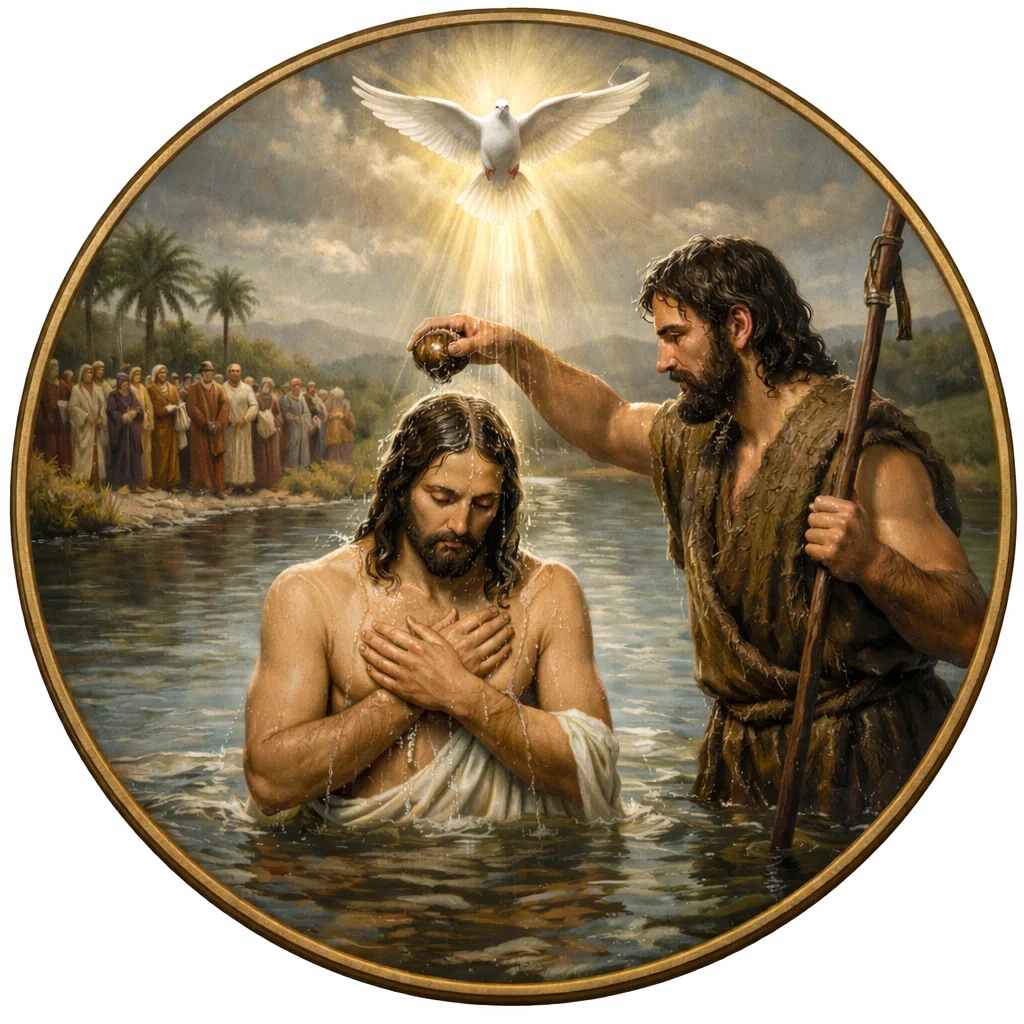
Se manifestarán realmente al mundo. Dejada atrás su vida común, Jesús se aproxima al río Jordán, donde en los últimos días una voz llamaba al pueblo al arrepentimiento. Una voz que manifestaba la venida de un nuevo tiempo para Israel. Una voz que estaba preparando el camino del Señor. Cuando Jesús se acercaba a las turbias aguas del Jordán, Juan, el último y el mayor profeta del viejo pacto, anunciaba que, tras él, vendría el Mesías prometido, aquel que limpiará la era de Dios, recogiendo el buen trino y lanzando al fuego la inservible paja. El bautismo que él estaba practicando era un bautismo preparatorio. El bautismo como ritual existía desde tiempos pretéritos en el antiguo Israel. Denominada mikvé, era un rito de purificación consistente en sumergirse simbólicamente en agua para restaurar la pureza del individuo ante Dios, tras haberse visto sometido a situaciones de suciedad moral o física. También el sacerdote debía bañarse con agua en un lugar santo antes de realizar el sacrificio (Levítico 16:24) Lavaos y limpiaos, quitad la maldad de vuestras obras (Isaías 1:16) Ahora el pueblo debía purificarse antes de recibir al Dios encarnado que se aproximaba.
Estando Juan llamando a una nueva vida al pueblo, cuando se percató de que aquel que había de venir; que aquel que restauraría la paz a la dañada creación de Dios, estaba ante sí, queriendo bautizarse bajo su mano.
Juan no entiende por qué quiere ser bautizado. Yo debo ser bautizado por ti. Solo tú puedes limpiar mis pecados-parece decirle. Mas Jesús insiste, así conviene que cumplamos toda justicia. Colocado en la fila de los pecadores, siendo Él el único justo, santo, sin mancha, se estaba colocando en tu lugar. Ubicado allá donde debías estar tú. Al igual que el sacerdote levítico, Jesús, el verdadero y definitivo sacerdote, se somete al rito para mostrar que Él es el único sacerdote de Israel, aquel que ofrece el definitivo sacrificio por los pecados del mundo, no con sangre de animales, sino con su propia sangre. Por la obediencia a la voluntad del Padre por parte de Jesús, capaz de cumplir toda la ley, tú has sido constituido justo.
Con su entrada en el agua, purificó todas las aguas del mundo para que, en tu bautismo, por medio de la promesa de Dios unida al agua, nazcas de nuevo. Jesús baja al agua como bajará al sepulcro.
Cuando subió del agua, los cielos fueron abiertos y vio al Espíritu Santo descendiendo sobre Él. La separación entre Dios y la tierra desaparece. Un anticipo de lo que habría de venir en los nuevos cielos y la nueva tierra. El tiempo se detiene. Dios se hace presente en sus tres personas. El Espíritu Santo desciende y reposa sobre Él. Ha sido proclamado ante el mundo el Ungido, el Christos, aquel sobre el que reposa la mayor y santa misión de la historia: reconciliar al mundo con Dios. Jesús sube del agua como subirá del sepulcro vacío a los cielos, a la diestra del Padre.
Ha sido ungido como profeta para predicar buenas nuevas a los pobres, a sanar a los quebrantados de corazón, a dar libertad a los cautivos y poner en libertad a los oprimidos (Isaías y Lucas 4:17-18) Ha sido ungido para profetizar que Él, el siervo sufriente, deberá padecer muchas cosas mas resucitará al tercer día (Mateo 16:21). Él es el profeta en quien culmina toda la esperanza israelita.
Ha sido ungido como rey eterno. Si los antiguos reyes eran ungidos con aceite por el sacerdote o profeta para cumplir una misión: respetar y hacer respetar la ley del Señor sobre Israel, ahora, Dios ha puesto sobre Sión su rey (salmo 2), cuyo reino no tendrá fin Su corona real es una corona de afilados espinos colocada sobre su cabeza en la cruz. Un rey siervo que se sometió al tormento para morir y resucitar por ti. Y su reinado en la tierra tuvo su principio aquel día en las aguas del Jordán.
Finalmente, se oye la poderosa voz de Dios que decía: Este es mi Hijo amado, en quien tengo complacencia. El Hijo de Dios, unido en una misma esencia al Padre, cumple totalmente su voluntad como el siervo amado por Él. En Isaías 42, Dios afirma: He aquí mi siervo, yo le sostendré; mi escogido, en quien mi alma tiene contentamiento; he puesto sobre él mi Espíritu; él traerá justicia a las naciones.
La versión Septuaginta traduce el siervo por Hijo de Dios. Estamos ante el Hijo de Dios y siervo de Dios que desciende a la tierra a cumplir la voluntad de aquel que lo envió: a cumplir toda la ley, comenzando por el bautismo, para finalmente recibir el precio de tus pecados en la Cruz. Desde este bautismo, el mundo lo sabe: el Padre y el Hijo son uno. Y El Padre se contenta con el Hijo grandemente. Lo ama hasta lo más íntimo de su inconmensurable se desde antes de la fundación del mundo (Juan 17:24) Y este mismo amor que siente por su Hijo lo tiene para el mundo porque Dios te amó tanto que ha dado a su Hijo unigénito para que todo aquel que en Él crea no se pierda, sino tenga vida eterna (Juan 3:16) EL amor de Dios consiste en que Él te amó primero y envió a su Hijo por propiación por nuestros pecados (1 Juan 4:9-10) Y lo ha hecho para que, amando a los demás, puedas mostrar este amor al mundo con el fin de que el mundo glorifique a Dios que está en los cielos.
Mira tu vida. Si amas a Dios y amas a tu vecino, has nacido de nuevo y lo has hecho porque Dios te amó primero. Dios no ve en ti tu suciedad, sino que en tu rostro ve a su amado Hijo que se colocó en tu lugar en el Calvario.
En su bautismo Jesús hizo visible su propósito y naturaleza: Él es tu Rey, sacerdote y profeta, el Hijo amado de Dios que, cargando sobre sus hombros el peso de tus pecados, murió en la Cruz para que tú pudieras vivir en Dios. El Hijo de Dios ha conseguido que de enemigo de Dios pasaras a ser su hijo y heredero de la vida eterna. Y todo empezó en el Jordán.
Que la paz de Dios, que sobrepasa todo entendimiento, guarde vuestros corazones y vuestros pensamientos en Cristo Jesús.
En Torre del Mar, a 11/1/2026.
In English:
THE BAPTISM OF JESUS
From the Jordan to the Throne through Calvary: Jesus, the Anointed of God
And suddenly a voice came from heaven, saying, “This is My beloved Son, in whom I am well pleased.” (Matthew 3:13–17, NKJV)
Do you feel loved by God? Do you feel understood by the Lord? What is God to you?
On this Sunday, we remember the baptism of Jesus. After reflecting in previous weeks, during the Christmas season, on His other two manifestations to the world, through His birth, and to the Gentiles in the visit of the Magi from the East, today we see Jesus revealed as the Prophet, Priest, and King promised to Israel.
After years of an ordinary life, possibly working with His father Joseph as a builder and carpenter in the towns of Galilee, the time came for the promise of the angel Gabriel to the Virgin Mary:
“Do not be afraid, Mary, for you have found favor with God.
And behold, you will conceive in your womb and bring forth a Son, and shall call His name JESUS.
He will be great, and will be called the Son of the Highest;
and the Lord God will give Him the throne of His father David.
And He will reign over the house of Jacob forever,
and of His kingdom there will be no end.” (Luke 1:30–33, NKJV)
And to Joseph, son of David:
“And she will bring forth a Son, and you shall call His name JESUS, for He will save His people from their sins.” (Matthew 1:20–21, NKJV)
These promises were now going to be truly revealed to the world. Leaving behind His common life, Jesus comes near to the Jordan River, where in recent days a voice was calling the people to repentance. A voice that announced the coming of a new time for Israel. A voice that was preparing the way of the Lord.
As Jesus approached the troubled waters of the Jordan, John, the last and greatest prophet of the old covenant, was announcing that after him would come the promised Messiah, the One who would clear God’s threshing floor, gathering the good wheat and throwing the useless chaff into the fire. The baptism John practiced was a preparatory baptism.
Baptism as a ritual already existed in ancient Israel. Called mikveh, it was a purification rite that consisted of symbolically immersing oneself in water to restore purity before God after situations of moral or physical uncleanness. The priest also had to bathe with water in a holy place before offering the sacrifice (Leviticus 16:24, NKJV).
“Wash yourselves, make yourselves clean; put away the evil of your doings from before My eyes.” (Isaiah 1:16, NKJV)
Now the people had to purify themselves before receiving the incarnate God who was drawing near.
While John was calling the people to a new life, he realized that the One who was to come, the One who would restore peace to God’s damaged creation, was standing before him, asking to be baptized by him.
John does not understand why Jesus wants to be baptized. “I need to be baptized by You,” he seems to say. “Only You can cleanse my sins.” But Jesus insists: “Permit it to be so now, for thus it is fitting for us to fulfill all righteousness.”
Standing in the line of sinners, while He alone was righteous, holy, and without blemish, He was taking your place. He was standing where you should have stood. Like the Levitical priest, Jesus—the true and final Priest—submits Himself to the rite to show that He is the only Priest of Israel, the One who offers the final sacrifice for the sins of the world, not with the blood of animals, but with His own blood. Through Jesus’ obedience to the will of the Father, by fulfilling the whole law, you have been declared righteous.
By entering the water, He purified all the waters of the world so that, in your baptism, through God’s promise joined to the water, you may be born again. Jesus goes down into the water just as He will go down into the tomb.
When He came up from the water, the heavens were opened, and He saw the Holy Spirit descending upon Him. The separation between God and the earth disappears. It is a foretaste of what will come in the new heavens and the new earth. Time stands still. God is present in His three persons. The Holy Spirit descends and rests upon Him.
The Anointed One has been proclaimed before the world—the Christ—upon whom rests the greatest and holiest mission in history: to reconcile the world to God. Jesus comes up from the water just as He will rise from the empty tomb and ascend to heaven, to the right hand of the Father.
He has been anointed as Prophet to preach good news to the poor, to heal the brokenhearted, to proclaim liberty to the captives and freedom to the oppressed (Isaiah; Luke 4:17–18, NKJV). He has been anointed to proclaim that He, the suffering Servant, must suffer many things and rise again on the third day (Matthew 16:21, NKJV). He is the Prophet in whom all the hope of Israel is fulfilled.
He has been anointed as eternal King. If the ancient kings were anointed with oil by priest or prophet to fulfill a mission—to keep and enforce the law of the Lord over Israel—now God has set His King on Zion (Psalm 2, NKJV), whose kingdom will have no end. His royal crown is a crown of sharp thorns placed on His head on the cross. A servant King who submitted Himself to suffering to die and rise again for you. And His reign on earth began that day in the waters of the Jordan.
Finally, the powerful voice of God is heard, saying: “This is My beloved Son, in whom I am well pleased.” The Son of God, one in essence with the Father, perfectly fulfills His will as the beloved Servant. In Isaiah 42, God says:
“Behold! My Servant whom I uphold,
My Elect One in whom My soul delights!
I have put My Spirit upon Him;
He will bring forth justice to the Gentiles.” (Isaiah 42:1, NKJV)
The Septuagint translates “Servant” as “Son of God.” Here we see the Son of God and the Servant of God who comes down to earth to fulfill the will of the One who sent Him: to fulfill the whole law, beginning with baptism, and finally to bear the price of your sins on the Cross.
From this baptism onward, the world knows it: the Father and the Son are one. And the Father greatly delights in the Son. He loves Him from the depths of His immeasurable being, from before the foundation of the world (John 17:24, NKJV). And this same love that He has for His Son, He has for the world, because:
“For God so loved the world that He gave His only begotten Son, that whoever believes in Him should not perish but have everlasting life.” (John 3:16, NKJV)
“In this the love of God was manifested toward us, that God has sent His only begotten Son into the world, that we might live through Him. In this is love, not that we loved God, but that He loved us and sent His Son to be the propitiation for our sins.” (1 John 4:9–10, NKJV)
He has done this so that, by loving others, you may show this love to the world, so that the world may glorify God who is in heaven.
Look at your life. If you love God and love your neighbor, you have been born again, and you have been so because God loved you first. God does not see your uncleanness; instead, in your face He sees His beloved Son, who took your place on Calvary.
In His baptism, Jesus made His purpose and nature visible: He is your King, Priest, and Prophet, the beloved Son of God who, carrying the weight of your sins on His shoulders, died on the Cross so that you might live in God. The Son of God has made it possible for you to pass from being an enemy of God to being His child and heir of eternal life. And it all began in the Jordan.
May the peace of God, which surpasses all understanding, guard your hearts and your minds in Christ Jesus. (Philippians 4:7, NKJV)
In Torre del Mar, on 11/1/2026.