Y fueron todos llenos del Espíritu Santo (Hechos 2:4)
Jerusalén estaba repleta de fieles. Se conmemoraba la fiesta de las semanas, llamada Pentecostés, cincuenta días desde la Pascua. Enmarcada dentro de una sociedad profundamente agrícola como Israel, Pentecostés era, en su origen, la fiesta de la siega. Los judíos daban gracias a Dios por los primeros frutos de la cosecha. Asimismo, la tradición judía relacionaba Pentecostés con el momento en que Dios entregó la Ley a Moisés en el monte Sinaí, después de aproximadamente cincuenta días de su salida de Egipto. Subiendo a Jerusalén, miles de judíos esperaban presentar las primicias de su patrimonio al Señor. Mas en lugar de entregar ofrendas, ellos iban a recibir el regalo prometido por los profetas siglos atrás: el Espíritu Santo.
Después de esto derramaré mi Espíritu sobre toda carne, y profetizarán vuestros hijos y vuestras hijas; vuestros ancianos soñarán sueños, y vuestros jóvenes verán visiones (Joel 2:28-29)
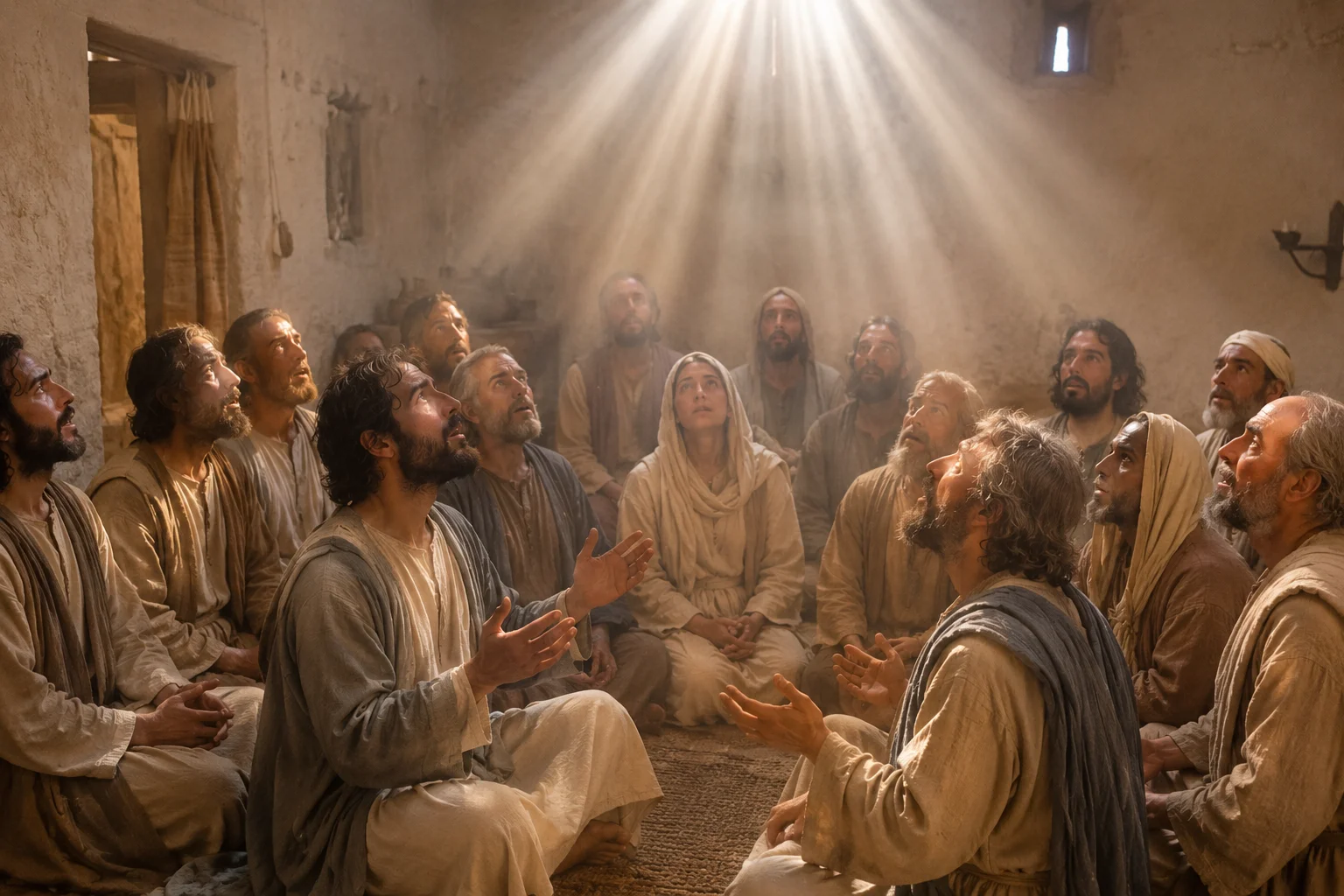
Reunidos los apóstoles, gozosos tras la Ascensión de Cristo a los cielos, resonaban aún en sus oídos la promesa de Jesús:
“Les mandó que no se fueran de Jerusalén, sino que esperasen la promesa del Padre. “Porque Juan ciertamente bautizó con agua, mas vosotros seréis bautizados con el Espíritu Santo dentro de no muchos días.” (Hechos 1:4-5)
El día llegó durante la fiesta de Pentecostés. Y de la misma manera que Dios, soplando aliento de vida en Adán, le entregó vida, ahora Jesús les estaba enviando su Santo Espíritu para darles nueva vida. Dios prometió que llegará el día en el que el Espíritu soplaría sobre los muertos en Ezequiel 37:9-10, resucitándolos en el valle de los huesos secos. He aquí el Espíritu de Dios que vivificó tu cuerpo mortal cuando estabas muerto en tus delitos y pecados (Ef 2:1-5)
En este Pentecostés, no se entregaron las cosechas, sino el Espíritu Santo. Y el Espíritu trajo a aquella habitación: fe, esperanza y amor.
Desde entonces el corazón de los apóstoles fue persuadido de sus pecados y se arrepintieron. Ahora creen en el Señor Jesús. En el instante en que reciben el espíritu de adopción por el cual claman “Abba Padre” (Romanos 8:15), ya no viven ellos, sino Cristo en ellos. Tienen la certeza de lo que se espera, la convicción de lo que no se ve (Hebreos 11: 1) Nada es imposible para aquel que tiene fe. He aquí la fe de Pentecostés. Justificados por la fe, tienen paz total con Dios (Romanos 5:1) La ley ya no les acusa ni condenan. No hay condenación en Cristo Jesús.
No temen ningún mal porque su corazón firme en el Señor. Saben que Cristo, exaltado a la diestra del Padre, ha derrotado por medio de la muerte al que tenía el imperio de la muerte (Hebreos 2:14) Se sienten renacidos para una esperanza viva por la resurrección de Cristo de los muertos. Esperan día y noche en Dios. Elevan su mirada a las cosas de arriba, donde está situado Cristo. Reciben la paz que Cristo les entregó. No tienen la falsa paz del mundo, sino la eterna paz que recibieron de su Señor.
Sienten el amor de Dios derramado en sus corazones por el Espíritu Santo. Ese amor que sangró por ellos en la Cruz. Mirando al Crucificado padecer en la Cruz por sus pecados, no pueden sino compungirse de sus pecados y amar más y más a aquel que dio su preciosa sangre por ellos en el cruel madero. Aquel que soportó humillaciones, haciéndose maldito, por puro amor. Si Dios nos ha amado así, piensan, debemos nosotros amarnos los unos a los otros. Por ello los apóstoles no pueden sino amar a sus hermanos. Recuerdan las palabras de Jesucristo: en esto conocerán que sois mis discípulos, si os amáis los unos a los otros. Saben que el cumplimiento de la ley es el amor (Romanos 13:10) Mas no solo aman a sus hermanos, también a sus enemigos. Si el propio Jesús perdonó a los que lo crucificaron, ellos hacen lo mismo con aquellos que los persiguen o vituperan. Los perdonan, oran por ellos y les hacen todo el bien posible.
Alabando a los demás, ellos se hacen pequeños. Recuerdan las palabras de su maestro: el que quiera ser el primero entre vosotros será siervo de todos (Marcos 10:44)
Ninguna palabra ociosa sale de sus bocas, sino que solo aquella que sea buena para la necesaria edificación (Efesios 4:29). Reciben la bendición del Señor por ser pacificadores, no generadores de conflictos. Se contentan con lo que tienen, porque saben que la raíz de todos los males es el amor al dinero. No se hacen tesoros en la tierra, porque aquí no está su corazón. Sus deseos y pensamientos se alinean con la voluntad de Dios.
Los apóstoles desde aquel día persisten en la oración y en la Santa Cena. Convencidos de que sin Cristo nada pueden hacer, acuden diariamente a los medios de Gracia instituidos por el propio Dios, para recibir la sanidad que sus almas requieren. Así, crecían día a día en Gracia.
El 21 de abril de 1738, el gran teólogo y compositor de himnos Charles Wesley sintió ese mismo Espíritu cuando, tras sentir su corazón extrañamente candente, escuchó: en el nombre de Jesús de Nazaret, levántate y cree y te serán sanadas todas tus debilidades. Él exclamó con ciega confianza en el Señor: Creo. Creo. La fe echó fuera todo miedo y ansiedad. El amor transformó su vida para vivir en Cristo. Confiado en su Salvador, Charles Wesley se lanzó a componer miles de himnos y sermones, llevando el Evangelio, junto a su hermano John, por toda Inglaterra, sin miedo a nada ni a nadie. Les movía el fuego del Espíritu.
El Espíritu Santo transformó a los primeros cristianos y a los Wesley en nuevas criaturas. La vieja levadura que los esclavizaba pasó. Habían nacido de nuevo Ahora el amor obraba en ellos por medio de la fe y la esperanza.
He aquí la obra del Espíritu. Aunque los apóstoles hablaron en lenguas de otros pueblos como señal de que el Evangelio se expandiría por todas las naciones, Dios no entregó dones extraordinarios como el hablar en lenguas o la sanidad a todos sus hijos, ni siquiera entre los primeros cristianos. Los reservó para ocasiones muy singulares, en las cuales estos instrumentos fueran herramientas de edificación. Todo buen árbol da buenos frutos. Y los frutos son estas virtudes: fe, esperanza y, sobre todo, amor. El que ama conoce a Dios. El que no ama a su hermano, por mucho que se tenga por cristiano, es peor que un pagano.
Ahora yo os pregunto, en presencia del Dios infinito ante quienes todos debemos de comparecer: ¿Estáis llenos del Espíritu Santo? ¿sois buenos representantes del Señor en la tierra? ¿os dejáis guiar por el amor derramado por el Espíritu? ¿toda palabra que sale de vuestra boca procede de Dios? ¿cada obra que realizáis es fruto del amor? ¿reina Dios en vuestros corazones? ¿amáis a Dios con todo vuestro corazón, mente y alma? ¿y a vuestro prójimo como a vosotros mismos? Meditad sobre ello ante Dios y sed sinceros.
Si sentís en vuestro corazón el amor de Dios, alabadle sin cesar, seguid sus sendas, acudid a Él en vuestras necesidades y caídas. Rogad: Señor, no quites de mi tu Santo Espíritu.
Si no os sentís llenos del Espíritu de Dios, clamad con más fuerza. Él no quiere que nadie se pierda, mas que todos alcancen salvación. Si vosotros sabéis dar buenas dádivas a vuestros hijos, ¿cuánto más vuestro Padre celestial dará el Espíritu Santo a los que se lo pidan? (Lucas 11:13) Rogad al Padre por el Consolador. “Purifícame con hisopo, y seré limpio;
lávame, y seré más blanco que la nieve” (Salmo 51:7) Él lo enviará y echará fuera toda condenación, muerte y duda.
Sálvanos, Señor, de toda frialdad espiritual, de toda caída y de todo pecado. Ayúdanos a seguir el ejemplo de los apóstoles en Pentecostés y de Charles Wesley que dieron testimonio de tus maravillas y te glorificaron con sus obras. Haz que podamos servirte siempre por medio del amor derramado por tu Espíritu en nuestros corazones. No nos desampares, Señor. Sé con nosotros hasta el último día. Que se haga tu voluntad y no la nuestra.
En Torre del Mar a 24/05/2026.
ENTECOST SUNDAY.
The work of the Spirit.
And they were all filled with the Holy Spirit (Acts 2:4, NKJV)
Jerusalem was full of believers. The Feast of Weeks was being celebrated, called Pentecost, fifty days after Passover. Within a deeply agricultural society like Israel, Pentecost was originally the feast of the harvest. The Jews gave thanks to God for the first fruits of the crop. Likewise, Jewish tradition related Pentecost with the moment when God gave the Law to Moses on Mount Sinai, about fifty days after their departure from Egypt. Going up to Jerusalem, thousands of Jews expected to present the first fruits of their possessions to the Lord. But instead of giving offerings, they were going to receive the gift promised by the prophets centuries earlier: the Holy Spirit.
“Afterward I will pour out My Spirit on all flesh; your sons and your daughters shall prophesy, your old men shall dream dreams, your young men shall see visions.” (Joel 2:28–29, NKJV)
The apostles were gathered together, joyful after Christ’s Ascension into heaven, still hearing in their ears the promise of Jesus:
“He commanded them not to depart from Jerusalem, but to wait for the Promise of the Father. ‘For John truly baptized with water, but you shall be baptized with the Holy Spirit not many days from now.’” (Acts 1:4–5, NKJV)
The day arrived during the feast of Pentecost. And just as God, by breathing the breath of life into Adam, gave him life, now Jesus was sending them His Holy Spirit to give them new life. God promised that a day would come when the Spirit would breathe upon the dead in Ezekiel 37:9–10, raising them in the valley of dry bones. This is the Spirit of God who made alive your mortal body when you were dead in your trespasses and sins (Ephesians 2:1–5, NKJV).
The Spirit brought into that room: faith, hope, and love.
From then on, the hearts of the apostles were convicted of their sins and they repented. Now they believe in the Lord Jesus. At the moment they receive the Spirit of adoption by which they cry “Abba, Father” (Romans 8:15, NKJV), they no longer live, but Christ lives in them. They have the assurance of things hoped for, the conviction of things not seen (Hebrews 11:1, NKJV). Nothing is impossible for the one who has faith. This is the faith of Pentecost. Being justified by faith, they have complete peace with God (Romans 5:1, NKJV). The law no longer accuses or condemns them. There is no condemnation in Christ Jesus.
They fear no evil because their heart is firm in the Lord. They know that Christ, exalted at the right hand of the Father, has defeated through death the one who had the power of death (Hebrews 2:14, NKJV). They feel reborn to a living hope through the resurrection of Christ from the dead. They wait day and night in God. They lift their eyes to things above, where Christ is seated. They receive the peace that Christ gave them. They do not have the false peace of the world, but the eternal peace received from their Lord.
They feel the love of God poured into their hearts by the Holy Spirit. That love which bled for them on the Cross. Looking at the Crucified One suffering on the Cross for their sins, they cannot but be broken over their sins and love more and more the One who gave His precious blood for them on the cruel wood. The One who endured humiliation, becoming a curse, out of pure love. If God has loved us like this, they think, we must love one another. Therefore the apostles can only love their brothers. They remember the words of Jesus Christ: by this all will know that you are My disciples, if you love one another. They know that the fulfilling of the law is love (Romans 13:10, NKJV). But they do not only love their brothers, they also love their enemies. If Jesus Himself forgave those who crucified Him, they do the same with those who persecute or insult them. They forgive them, pray for them, and do all the good they can.
By praising others, they make themselves small. They remember the words of their Master: whoever desires to be first among you shall be servant of all (Mark 10:44, NKJV).
No idle word comes out of their mouths, but only what is good for necessary edification (Ephesians 4:29, NKJV). They receive the blessing of the Lord for being peacemakers, not troublemakers. They are content with what they have, because they know that the root of all evils is the love of money. They do not store up treasures on earth, because their heart is not here. Their desires and thoughts are aligned with the will of God.
From that day, the apostles continue steadfastly in prayer and in the Holy Supper. Convinced that without Christ they can do nothing, they go daily to the means of grace instituted by God Himself, to receive the healing their souls need. Thus, they grew day by day in grace.
On April 21, 1738, the great theologian and hymn writer Charles Wesley felt that same Spirit when, after feeling his heart strangely warmed, he heard: in the name of Jesus of Nazareth, arise and believe, and all your weaknesses will be healed. He cried out with blind trust in the Lord: I believe. I believe. Faith cast out all fear and anxiety. Love transformed his life to live in Christ. Trusting in his Savior, Charles Wesley began to compose thousands of hymns and sermons, bringing the Gospel, together with his brother John, throughout England, without fear of anything or anyone. They were moved by the fire of the Spirit.
The Holy Spirit transformed the first Christians and the Wesleys into new creatures. The old leaven that enslaved them passed away. They had been born again. Now love worked in them through faith and hope.
This is the work of the Spirit. Although the apostles spoke in tongues of other peoples as a sign that the Gospel would spread to all nations, God did not give extraordinary gifts such as speaking in tongues or healing to all His children, not even among the first Christians. He reserved them for very special occasions, in which these instruments would be tools for edification. Every good tree bears good fruit. And the fruits are these virtues: faith, hope, and above all, love. He who loves knows God. He who does not love his brother, no matter how Christian he considers himself, is worse than a pagan.
Now I ask you, in the presence of the infinite God before whom we all must appear: Are you filled with the Holy Spirit? Are you good representatives of the Lord on earth? Do you let yourselves be guided by the love poured out by the Spirit? Does every word that comes out of your mouth come from God? Is every work you do a fruit of love? Does God reign in your hearts? Do you love God with all your heart, mind, and soul? And your neighbor as yourself? Meditate on this before God and be sincere.
If you feel in your heart the love of God, praise Him without ceasing, follow His ways, go to Him in your needs and falls. Pray: Lord, do not take Your Holy Spirit from me.
If you do not feel filled with the Spirit of God, cry out more strongly. He does not want anyone to be lost, but that all reach salvation. If you know how to give good gifts to your children, how much more will your heavenly Father give the Holy Spirit to those who ask Him? (Luke 11:13, NKJV). Pray to the Father for the Comforter. “Purge me with hyssop, and I shall be clean; wash me, and I shall be whiter than snow.” (Psalm 51:7, NKJV). He will send Him and cast out all condemnation, death, and doubt.
Save us, Lord, from all spiritual coldness, from all falling, and from all sin. Help us to follow the example of the apostles at Pentecost and of Charles Wesley, who bore witness to Your wonders and glorified You with their works. Make us able to serve You always through the love poured into our hearts by Your Spirit. Do not forsake us, Lord. Be with us until the last day. Let Your will be done and not ours.
In Torre del Mar on 24/05/2026.